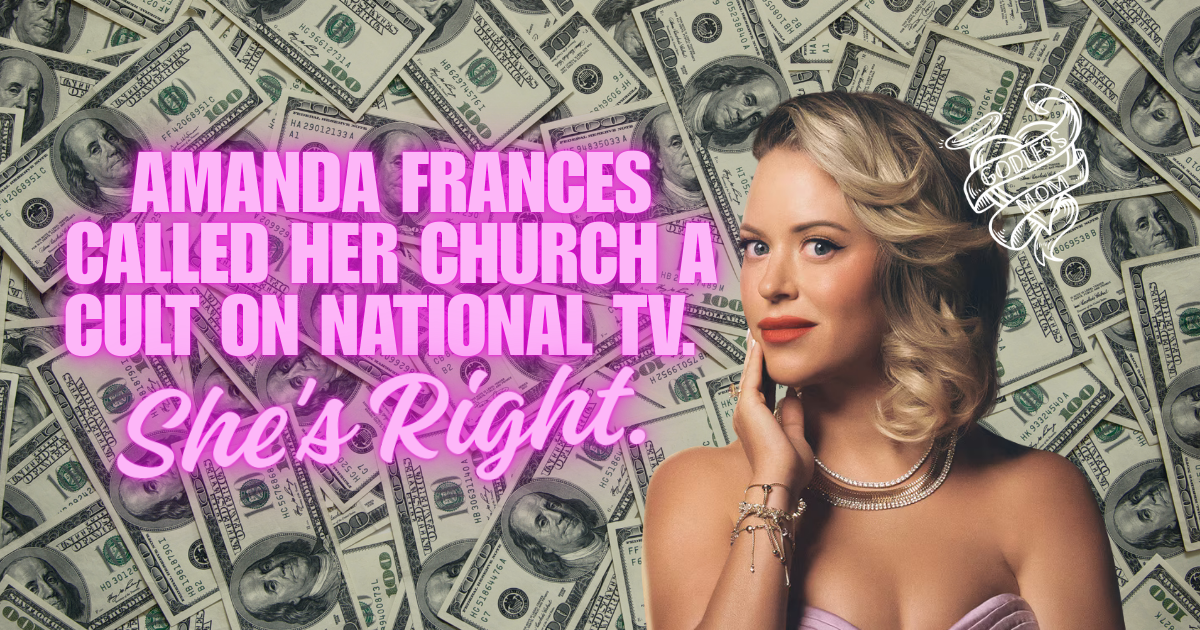
Note: I’ve written about religious trauma, cult dynamics, and deconstruction for over a decade. This piece looks at why Amanda Frances calling her former church a cult matters, and why mainstream religious abuse still gets minimized.
Twelve years. Twelve goddamn years of writing about high-control religion and cult dynamics and the very specific kind of damage that happens when you hand a human brain to an authority figure with a persecution complex and a collection plate, and I've watched it bounce off the public consciousness like a gospel pamphlet bouncing off my SuperAtheist force field.
Twelve years of screaming into the particular void that is religious trauma discourse, watching people's eyes go soft and distant the moment you use the word cult about anything with stained glass and a functioning boiler room. But trust Bravo — BRAVO — to one-up twelve years of my entire writing career and announce it to a global audience on a network show about rich women in LA who argue about pasta and owning it.
I'm not even mad. I'm a little proud of Bravo, actually.
Amanda Frances was right to call her former church a cult on the Real Housewives of Beverly Hills because cult dynamics are about control, punishment for questioning, and what it costs you to leave and it is never about whether the building looks normal from the outside. Let's take a closer look.
Who is Amanda Frances?
For the uninitiated: Amanda Frances is the new housewife on this season of the Real Housewives of Beverly Hills. She's a money mindset coach (which is what happens when prosperity gospel gets a spray tan, a ring light, and a sales funnel), she has bangin' hair and the polished, high-gloss energy of a woman who could sell abundance to an IRS auditor mid-collections call.
But before all that — before the manifestation retreats and the Rich as F*ck empire — she spent two years in her early twenties inside a church she describes, correctly, as a cult.
There’s something uniquely American about taking a twenty-something in Florida, a place practically engineered for bad choices, warm beer, and catastrophic romance, and stuffing them into a church regime where every normal human impulse gets treated like a live hand grenade. No dating. No drinking. No honest contact with home unless you wanted it rerouted through guilt and control. They weren’t just managing her behaviour. They were trying to fumigate the human right out of her. Strip the wiring, bleach the instincts, and leave behind one of those eerie smiling church girls who says she’s “at peace” while looking like she hasn’t taken a full breath since the fucking Bush administration.
Understandably, this would not do for Amanda. She finally shoved everything she owned into her car on Halloween night (because apparently even her escape had the instincts of a gothic novelist) and drove to her sister's.
Years Later, On RHOBH...
Dorit Kemsley's response to learning this was, apparently, to file it away for later use.
Let me park the car here for a moment because I need you to appreciate the full architecture of what that means:
A woman disclosed two years of psychological manipulation, isolation, and religious abuse, the kind that rewires actual brain chemistry in ways researchers are still mapping, and another woman, a fully grown adult human who has herself disclosed various traumas on this same cursed tele novella from hell, heard every word of that and thought:
Interesting. I'll keep that.
She tucked it away. Mentally scribbled, Amanda Frances church was a cult, and tossed it in the back of her mind like a crumpled receipt at the bottom of a Birkin bag. Like a screenshot you save because someone just ain't rubbin' you right.
And then. And then!
She pulled it out at a dinner table, in front of cameras, in 2026, like it was a photo of her shitzu's quinceañera and not a person's worst years.
The audacity would be impressive if it weren't so perfectly on-brand for exactly how the world treats religious abuse.
This Is Why “Cult” Was the Right Word
Now. Here is what actually makes something a cult, and I am telling you for the last time and also the fiftieth time since 2014: it is NEVER about the beliefs. Whether they baptize by sprinkling or full submersion, whether the communion wafers are gluten-free, whether the worship band plays original compositions or just an absolutely unhinged eleven-minute cover of Oceans because the Spirit is REALLY moving tonight and the drummer has just completely lost the plot. It's irrelevant, all of it, decorative, window display.
What you're looking for is underneath: Can you question the person at the top? Can you actually leave? And if you do, what does it cost you? Your friends? Your family? Your entire internal operating system for understanding who you are and what reality is?
If you're nodding right now, it's not because of Amanda Frances.
Mainstream churches have been running this exact playbook since before your grandmother was heels up on her wedding night and they've been getting away with it because the congregation is too large and too respectable and too embedded in the community infrastructure for anyone to say the word out loud without being called hysterical. At fifty members it's a cult. At five thousand it's a megachurch with a goddamned podcast, a Twitch stream, and a Wednesday night Bible group called something like Ignite or Elevate or The Thrive Collective or whatever gerund felt most aspirational to whoever the fuck designed the logo in 2019.
The methodology is identical. The branding is the only thing that changed.

Amanda has been writing about this since 2011. She put it in her book. She gave the interviews. She processed fifteen years of it publicly and in 2026 it still got deployed as dinner table ammunition by a woman in a dress she will only ever wear once.
Not as something that happened to a person.
As fucking dirt.
As a card you play when you're losing. Like trauma is just currency you liquidate when you need to win a point.
Why You Should Care About Amanda Frances Saying “Cult”
We do this with religious abuse in a way we do not do with anything else. Say you left a controlling relationship and the room goes quiet and respectful. Say you left a controlling church and somewhere, someone is already calculating whether that makes you unstable, or dramatic, or the kind of person who probably just couldn't handle a bit of structure.
There are people reading this right now who still won’t use the word cult for what they lived through because it all appeared too normal. There was a parking lot. There were potlucks. The pastor wore jeans. The worship leader had a beard and an acoustic guitar and a whole TED Talk thing going on. The youth group did volunteer days and somebody’s mom made baked ziti and from the outside it all looked so aggressively ordinary that even now, saying the word abuse can feel theatrical.
That’s exactly how religious abuse gets away with murder.
Did your church look normal from the outside?
We treat it like it only counts if it comes with a compound, a charismatic man with six wives, and a Netflix docuseries that's trending on Bluesky. If it happens under fluorescent lights in a fellowship hall with bad coffee and a bulletin board for the women’s retreat, we call it “a tough church experience.” We call it “hurt feelings.” We call it “getting offended.” We will use literally any phrase in the English language before we admit that a whole lot of mainstream religion runs on the same machinery as every other coercive system: control, fear, isolation, obedience, and punishment for noncompliance.
That’s the real reason Amanda saying it out loud on television matters. Not because Bravo suddenly became a trauma-informed public service, Cheeses forbid, but because religious abuse almost never gets treated with the weight it deserves. You know it's true. It gets downgraded, softened, filed under “messy” or “complicated” or “well, every church is different.” People hear church and their brains supply potlucks, parking lots, and a pastor in sneakers. They do not picture a system getting inside somebody’s head and teaching them to distrust their own instincts for fifteen years after the escape.
But that’s what it does. And when someone finally says, No, that was a cult, the world’s first impulse is still to check the branding before it believes them.
So no, the parking lot is not the test. The potluck is not the test. The pastor’s relaxed little denim vibe is not the test. The test is always the same: what happens when you question, what happens when you leave, and how much of yourself they think they get to keep afterward.
Listen, Amanda may be in the manifestation trade: part preacher, part salesperson, part spiritual DJ, spinning wealth consciousness for the wounded and well-moisturized...
...but she was also right.
A lot more people are right than we’re comfortable admitting. And if that makes some viewers squirm in their banquettes over dinner, good. Let them squirm. Amanda has a Bravo platform, now, and we know she knows how to use it.
If you enjoyed this post, you'll enjoy my book, Don't Panic, But You Might Be An Atheist. Read it today!




Comments
Join the conversation. New comments are reviewed before appearing.
I have to say I love this, Courtney.
I say this is a gay man. I knew that I was gay when I was three or four years old, as I’ve written here before. I didn’t know what “it“ was, And I didn’t know what it meant. I certainly didn’t know about sex. but I knew that it made me different from other boys in a way that involved to other boys. And I also knew without a doubt that I should not talk about it, not with anybody. I finally discovered the word “homosexual” in a dictionary When I was about 10, and I knew that that word applied to me.
I never had any problem with being gay, I was only Concerned with the possible consequences to my life and career. That’s why it took me until I was 21 to finally come out, because I was tired of hiding, I was tired of having no romantic life, I was tired of falling in love with my straight friends.
But in the 55 years since that time, I have met plenty of men And women whose lives as gay people were entirely poisoned by toxic religious belief. They’ve learned and internalized that the finest part of themselves— The part that connected and wanted connection with other human beings, that wanted sex with someone they cared about— The finest part of themselves was toxic, dangerous, sinful, terrible, ugly, and worst of all, an offense to a god that they could not see and they never heard from. And no matter How much they prayed to that God, how much they wanted that god to change them, no matter what they promised That God, it was always always always silent, except for the reverberating message that their very nature and very humanity was sick and dirty.
And this was coming from even the nice religions, Though to be be fair, that has changed drastically.
they were carefully taught to hate themselves. And it was not something they could ever escape from. My brother was such a one. He wasn’t poisoned by toxic religious belief, but toxic religious belief supplied the poison regardless. Centuries and millennia Of a slow drip of poison. my brother died of murder or suicide or both in a Mexican desert 24 years ago. He was so poisoned that he never told me, His very out and proud gay brother, that he was gay until after he had destroyed his life. And although I’ve had every reason To despise the poison that religion puts out there before, I will never ever forgive the loss of my brother.
The message he got from everyone around him Was that he was never going to be good enough. The message he got from toxic religion was that his very nature was never going to be good enough. And he bought that whole line To the detriment of his life.