
If you believe in the resurrection, then there is a giant rabbit breaking into your house in a few days.
He has a basket. He has chocolate. He means well.
But nobody invited him, nobody can explain where he came from or what his relationship to Jesus Christ actually is, and if you sit with that image for longer than four seconds (a six-foot lagomorph with pastel eggs and ninja skills) you will understand that Easter is not a holiday so much as it is a fever dream of fertility rites that two thousand years of repetition have somehow normalized into a ham dinner.
I have been to Easter dinners. I have sat at those tables. I have watched the glazed ham sweat under fluorescent kitchen light while hands are clasped and veiled threats of hell are gently whispered over it. I have eaten the hot cross buns, trying not to picture a bloodied Christ nailed to that sweet little cross in the middle. And what I kept thinking, every single time, with the particular clarity that only comes from sitting between a born-again God Bot and a passive-aggressive agnostic at a holiday table, was: where did any of this nonsense come from?

Not Jesus. That much I can tell you right now. Or... not only Jesus. Jesus is in here somewhere, lost between the chocolate rabbits and the Pagan fertility rites and the German immigrants and the pre-industrial pork preservation industry. It's like Jeeby and his open-toed sandals wandered into the narrative like a man who crashed his neighbour's party and left with half the guest list.
This is the story of that party. And it is spectacular.
The Name. Let's Start With The Name, Because The Name Is Already A Crime.
"Easter."
Say it out loud: Easter.
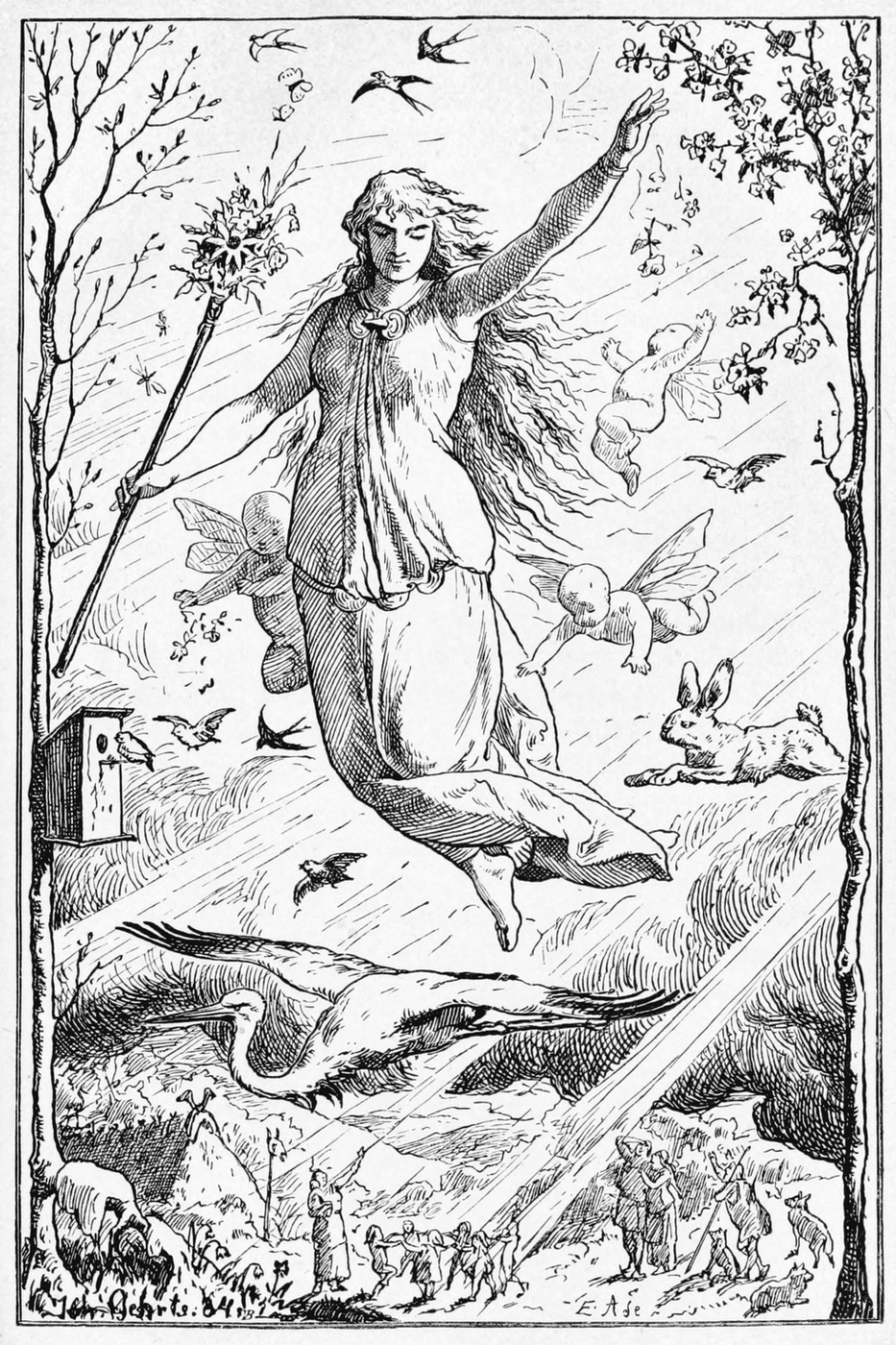
Now say "Eostre." The Anglo-Saxon goddess of spring and dawn, documented by the Venerable Bede, a monk, for the love of all that is fermented, a monk, in his 8th-century text De Temporum Ratione. In it he notes, with what I choose to imagine was a deeply weary expression, that the month Christians had taken to celebrating their resurrection holiday was named after this goddess, whose festivals were held in her honour in the spring.
Eostre. Easter. You see it. You cannot unsee it. I'm sorry.
In most other languages on earth, the word for Easter comes from Pascha, the Latinized Greek form of Pesach, the Jewish Passover, because the Last Supper was a Passover Seder. The early church calendar was built on top of Jewish holy days like an ecclesiastical strip mall over an ancient burial ground.
But in English? We kept the goddess. We kept her name, we kept her month, and we filled it with chocolate eggs and plastic grass and gave the whole thing to the children without a single explanatory footnote.
This could be the most spectacular act of cultural osmosis ever documented. I might also be high.
The Date: A Lunar Pagan Calendar With a Crucifix
Easter does not have a fixed date. You know this. You've been mildly annoyed by this every year of your adult life when you try to book flights or plan a weekend and Easter has apparently moved again like some kind of theological Spirit Halloween.
It falls on the first Sunday after the first full moon after the spring equinox.
Marinade on that. A holiday commemorating the resurrection of the Christian saviour is scheduled according to the moon and the sun's position relative to the tilt of the earth.
Is this Biblical instruction? No.
Is this something Jesus said? No.
Instead, it's ancient astronomical calendar-keeping. the same kind that governed spring equinox festivals across every major civilization on earth, from the Persians to the Mayans to Stonehenge.
My friends, this evil, it whiffs of Pagans!
You know that Christianity did not create the spring festival. Instead, Christianity looked at the spring festival and said: we'll take it from here. Which, fine. Aggressive. Very colonizer of you. But no one can deny it was efficient. S'pose.
The Eggs, Or: How Fertility Symbols Infiltrated Your Refrigerator
Here is what I need you to understand about the Easter egg: it was at the party before Christianity arrived, it will be at the party long after all of this is a footnote in someone's history textbook, and it does not care about your theology.
Decorated eggs as symbols of rebirth and fertility appear in ancient Egyptian, Persian, and Roman spring celebrations. The Persian festival of Nowruz, which is still celebrated today, still involving decorated eggs, still happening every spring equinox, three thousand-plus years old and doing great, thank you for asking, has had eggs on the table since before the Bible hit the bestseller list. The tradition of dyeing and decorating eggs predates Christianity in multiple cultures simultaneously, independently, because humans looked at eggs and thought: yes, this is a thing that contains life and then releases it, this is exactly the kind of object I want at my spring celebration, give me that object.
The Church eventually co-opted the egg, as you know, cracked shell as empty tomb, new life emerging, the whole metaphorical package. Listen, it makes sense. You take a symbol that humans have been using for three thousand years to mean life begins here, and you point it at your specific resurrection narrative, and it fits like it was made for it. It wasn't made for it. But it feels like it fits.
The problem (and this is the problem the Church has had with basically every single tradition it came in contact with) is that the egg didn't need them. The egg was already doing fine. The egg had been the symbol of spring and rebirth and fertility across Egypt, Persia, and Rome before Christianity existed, and it would have kept right on being that whether or not anyone decided to give it a spiritual makeover. The Church didn't give the egg meaning. It borrowed meaning the egg already had, and if you look closely enough, that is the story of almost every piece of Christian iconography you've ever encountered. The Easter egg is just the one sitting on your kitchen counter in a paper nest, being obvious about it at the moment.
The Easter egg is a 3,000-year-old fertility symbol wearing a pastel bow, and promising the only resurrection that has ever actually delivered: the one that ends in chocolate.
The Bunny: Absolutely Unhinged, Entirely Pagan, Completely Unstoppable Easter Tradition
Now, we have to talk about the rabbit.
Specifically I want to talk about the fact that a giant magical rabbit who delivers candy to children in the night has become one of the defining images of a holiday commemorating the death and resurrection of a religious figure, and nobody — nobody — seems to find this as cosmically strange as it is.
For a lifer atheist, it's all just a bit much.
There is no giant rabbit in the Bible. I want to be very clear about this. There is no candy either. There are no plastic eggs with the sticker residue that never fully comes off. While it may be true that Jesus said a great many things, we can rest assured none of them were "and also some Cadbury Mini Eggs."
Either Easter comes from the Pagan tradition or Donnie Darko was really a documentary about time travel. Hares were sacred animals in many ancient, Pagan European cultures, as symbols of the moon, of fertility, of the particular frenetic spring energy that makes everything want to reproduce immediately. There is a folk tradition connecting hares to Eostre specifically, our goddess friend from earlier. The rabbit was her spirit animal, or close enough to it that the association stuck like hot cross bun glaze to a paper bag.
The specific figure of the Osterhase (the Easter Hare who brings eggs to children) appears in German records as far back as 1572, and in the writings of a physician named Georg Franck von Franckenau who was documenting the tradition with the exhausted precision of a man who had clearly seen too many children lose their minds over hidden eggs.
German immigrants brought the Osterhase to Pennsylvania in the 1700s. Over the next two centuries, the hare became a bunny, the eggs became candy, the candy became a multi-billion dollar industry, and, now, Jeff Bezos is the one delivering eggs to children every year.
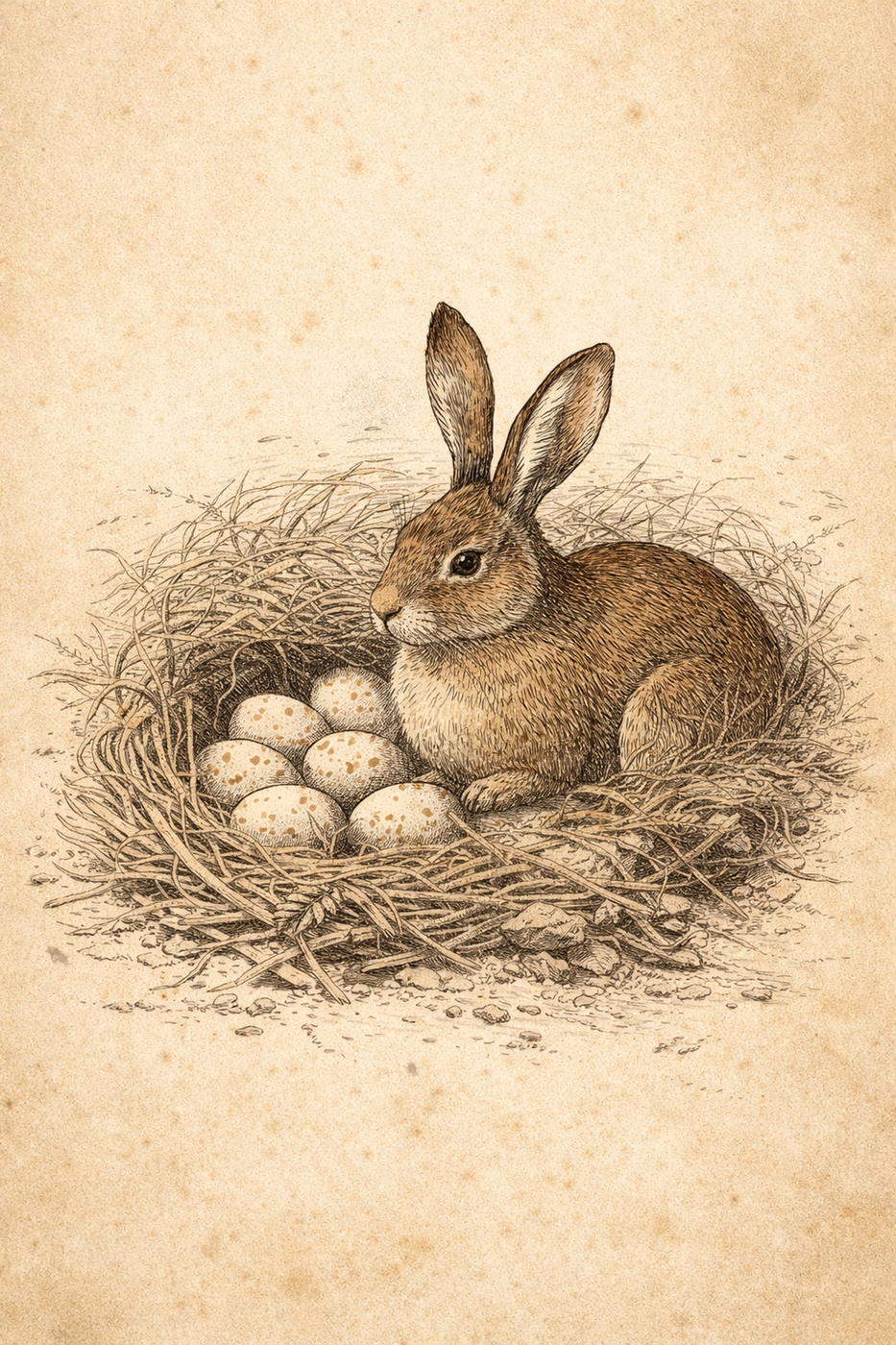
There's a specific bit of folklore that I love with my whole heart: the reason ancient people thought hares laid eggs (the origin of this whole egg-delivering rabbit mythology) is that hares nest on the ground, in the abandoned nests of lapwings, and people kept finding hares near egg-filled ground nests and drew the only logical conclusion available to them, which was that the hare had laid those eggs. This is wrong. This is spectacularly, magnificently wrong. And from that single, glorious misunderstanding, the Easter Bunny may have eventually been born.
I find this deeply comforting, the idea that the entire mythology descends from someone in ancient Europe watching a hare sit near a bird's nest and getting confused. This is absolutely something me and my neurodivergent mind would do.
The Ham. Let's Talk About The Ham.
You may be wondering when we are going to get to the ham. The ham is the least mystical item on the Easter table and yet it is arguably the most historically interesting, because the reason your family serves ham at Easter is not theological. It is not spiritual. It is not even traditional in any meaningful, ancient sense. It is logistical.
In pre-industrial Europe, pigs were slaughtered in the late autumn. The meat was cured over the winter. By spring, the ham that had been salted and hanging in the cold since November was finally ready to eat. That is it. That is the whole story. Easter is in spring. The ham was ready in spring. They were in the same room at the same time. A tradition was born. Big Daddy J didn't mandate the ham. Fermentation mandated the ham.
I find the ham to be the most honest tradition on the table. It does not pretend to be anything other than what it is: preserved pork that was ready in April. It has no mythology. It was not sacred to a goddess. It did not descend from an ancient fertility rite. It just showed up because the timing worked out, and now it sits at the centre of your Easter table sweating gently under your Uncle Leon's slurred and quite sweary delivery of grace.
Why I Think That's Beautiful
Here is what I keep coming back to, every time I sit at one of those Easter tables, watching the scalloped potatoes disappear and the children hunt for eggs: nobody invented this whole thing sitting in a room with a plan. There was no committee. There was no branding document. There was no single moment when someone decided that the holiday of the resurrection would involve a Pagan goddess's name, a lunar calendar, a 3,000-year-old fertility symbol, a mythological rabbit born from an ornithological misidentification, and a piece of cured pork that was simply ready when the party began.
It happened the way most human things happen. Slowly. By accumulation. One people encountered another people's spring festival and borrowed the best parts. A name stuck. A symbol proved too universal to discard. A child found a nest full of eggs next to a hare and told everyone, and the story spread, and the story changed, and centuries later a German immigrant packed the story into a trunk and brought it to Pennsylvania and now it is a billion-dollar candy industry. Each generation took what the last one left them, added something of their own, and handed it forward without explanation.
Until it hit the boomers and it got monetized... but that's another post entirely.
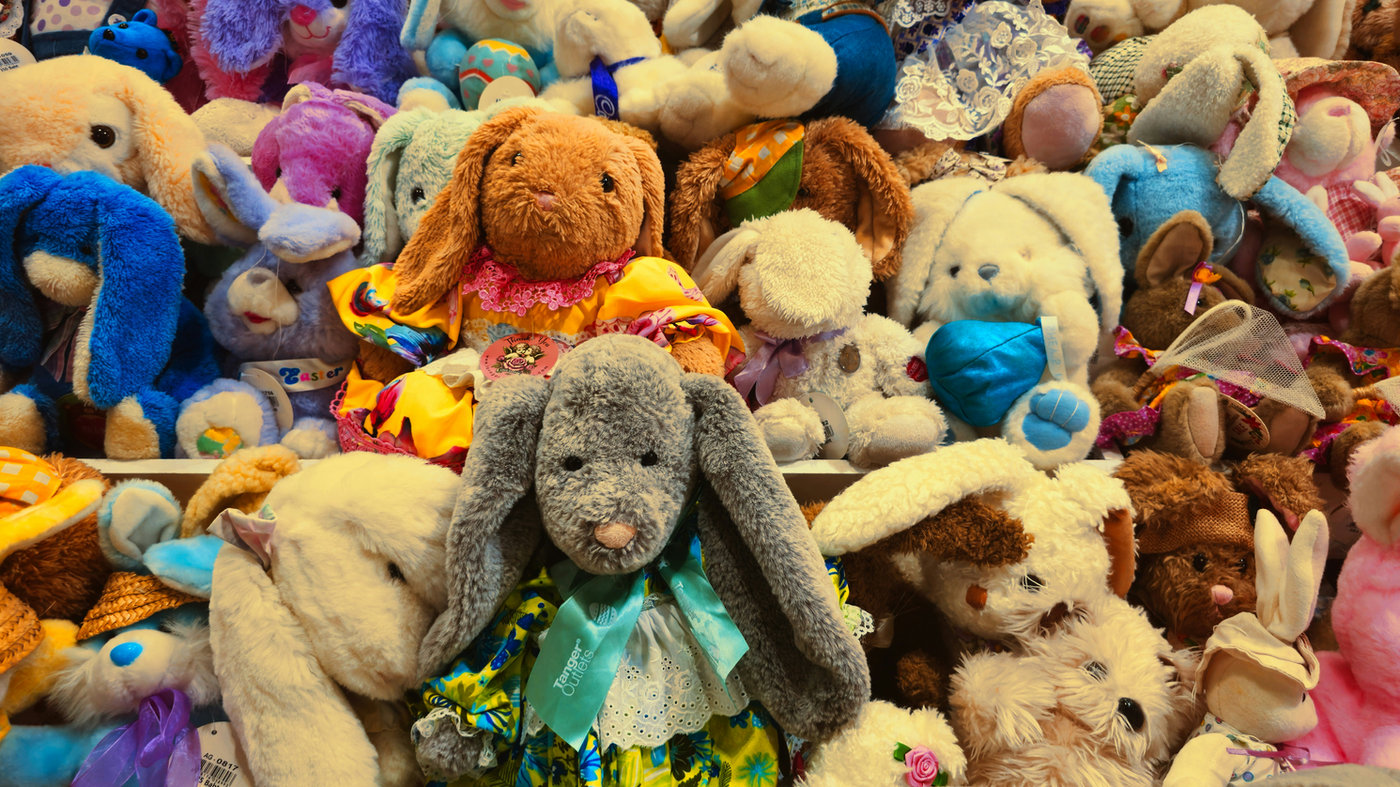
Is it theft? Yes. Okay, some of it is absolutely theft, let's be honest, the Church has some explaining to do, but underneath the appropriation and the colonial overlay and the aggressive monetization, there is something genuinely beautiful happening. Humans looked at the return of the light and the warmth and the green things coming back from the ground, and they celebrated. They celebrated across every culture and every century and every continent that had a winter to recover from. They used whatever symbols they had, eggs, hares, flowers, fire, newly cured meat, to mark the moment when death ended and life came back. They didn't agree on what it meant. They didn't need to. The celebration itself was the agreement.
I am an atheist. I do not believe in the resurrection. I do not believe a six-foot rabbit is coming. I am not going to pretend that the hot cross bun did not make me picture what it was depicting because I have the visual imagination of a forensic pathologist and there is no helping it.
But I will absolutely eat the chocolate. I will hide the eggs for the kids. I will serve the ham (which, I will remind you, carries the theological weight of a refrigeration problem from the 1400s) and I will sit at that table with my family, the believers and the non-believers alike, and I will appreciate that we are all, without meaning to be, doing what humans have done at the turn of every spring for as long as there have been humans: showing up, sharing food, and agreeing, wordlessly, that spring and growth and progress is worth celebrating.
Every single tradition at your Easter table is stolen. Every name, every symbol, every ritual descends from something older than the theology it got attached to. None of it was original. All of it is ours.
I think that's beautiful.
Books you might like on the topic:
The Woman's Encyclopedia of Myths and Secrets
The Golden Bough: A Study of Magic and Religion: Volume
Pagan Christmas: The Plants, Spirits, and Rituals at the Origins of Yuletide
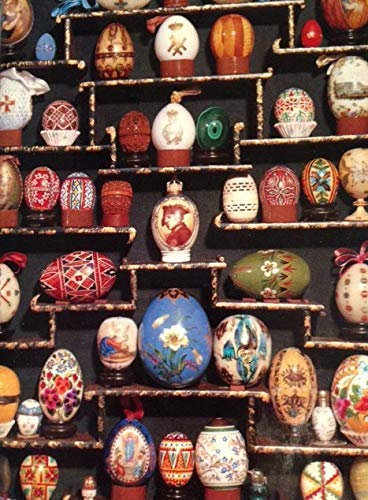
Newall, Venetia. An Egg at Easter: A Folklore Study
Sources (Because we're atheists)
Eostre, Wikipedia
Bede, De Temporum Ratione (The Reckoning of Time), 725 AD, Chapter 15.
Council of Nicaea, 325 AD. The formula for calculating Easter was codified here and remains in use.
Newall, Venetia. An Egg at Easter: A Folklore Study. Routledge & Kegan Paul, 1971.
Nowruz: The Persian New Year, UNESCO Intangible Cultural Heritage. Celebrated on the spring equinox.
Guiley, Rosemary Ellen. The Encyclopedia of Witches, Witchcraft and Wicca. Facts on File, 2008.
Green, Miranda. Animals in Celtic Life and Myth. Routledge, 1992.
Von Franckenau, Georg Franck. De Ovis Paschalibus (On Easter Eggs), 1682.
Smith, Andrew F. The Oxford Companion to American Food and Drink. Oxford University Press, 2007.



Comments
Join the conversation. New comments are reviewed before appearing.
Sign in or verify your email to leave a comment.