
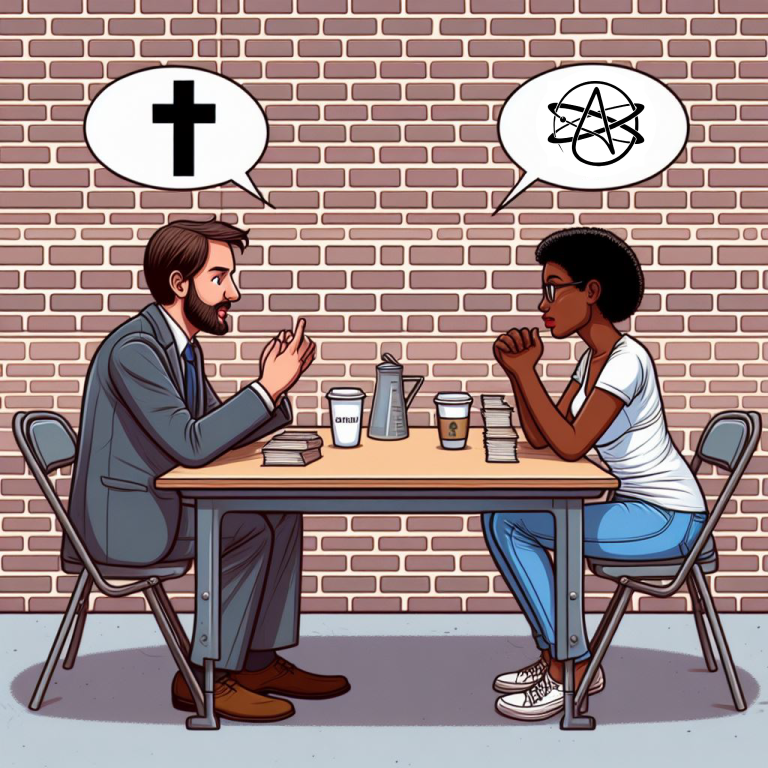
Bookmark this one before Thanksgiving. You know why.
Debating religion as an atheist can be akin to walking a tightrope over a Nickelback concert. One misstep, and you're in the shit. In my opinion, it's not really a route to truth but more of an intellectual dick-measuring contest. Often, it descends into bickering about the minutia of holy texts, which is my no-no zone. For me, a lifer atheist, the Bible means as much as what Kate Middleton is wearing to her fancy fuck-the-poor ball, which is to say it means sweet, fancy, fuck all. In my eyes, debating the Bible's far-fetched yarns can be compared to debating which character has a longer tail in Paw Patrol: A complete fucking waste of my time.
But that's just my perspective. I am also capable of realizing that chipping away at the credibility of the Big Book can help others free themselves from harmful dogma. It's just not for me. And, if I can take the liberty of giving some of you a little digital spanking, I'd suggest it's not for many of you, either. It's an art form that requires not just a solid understanding of the subject but also a finesse in handling conversations that tread the fine line between healthy debate and trolling for internet points. So, how does one master this art? Let’s explore.
The 13 Logical Fallacies in Religious Debates: The Cheat Sheet
Every one of these will eventually be aimed at you. Most of them will be aimed at you by Tuesday. Know them on sight, and notice, with appropriate humility, how easy they are to commit yourself.
| Fallacy | What it is | What it sounds like |
|---|---|---|
| Appeal to Ignorance | Claiming something is true because it hasn’t been proven false (or vice versa) | “You can’t prove God doesn’t exist, so he does.” |
| Strawman | Misrepresenting an argument to make it easier to attack | “So you’re saying the universe just popped out of nothing for no reason?” |
| Ad Hominem | Attacking the person instead of the argument | “You’re only an atheist because you want to sin without guilt.” |
| False Dichotomy | Presenting only two options when more exist | “Either God created the universe, or it created itself. Pick one.” |
| Circular Reasoning | Using the conclusion as one of the premises | “The Bible is true because it’s the word of God, and we know that because the Bible says so.” |
| No True Scotsman | Redefining a group to exclude inconvenient examples | “Real Christians would never do that” (after a Christian does exactly that) |
| Appeal to Authority | Treating a claim as true because an authority figure said so | “My pastor has a doctorate in theology, so he’d know.” |
| Appeal to Emotion | Using feelings instead of evidence to win a point | “Don’t you want to see your grandmother again?” |
| Appeal to Tradition | Claiming something is right because it’s always been done that way | “Billions of people have believed for thousands of years. They can’t all be wrong.” |
| Argumentum ad Populum | Claiming something is true because a lot of people believe it | “Most of the world is religious, so there’s probably something to it.” |
| Red Herring | Introducing an irrelevant point to derail the conversation | Bringing up Stalin the second atheism comes up in a debate about evidence |
| Special Pleading | Applying a rule to everything except your own position | “Everything needs a cause. Except God.” |
| Moving the Goalposts | Changing the criteria for evidence after it’s been met | “That’s not real evidence, I need something more” (repeated forever) |
The 4 Main Arguments for God and How to Counter Them
Underneath nearly every religious debate, it’s one of these four wearing a different outfit.
The cosmological argument (first cause)
Everything that exists has a cause. The universe exists. Therefore the universe has a cause, and that cause is, conveniently, the exact deity of whoever happens to be making the argument. The counter: the rule either applies to everything or it doesn’t. If everything needs a cause, so does God. If God gets an exemption, that’s special pleading (row 12 of the table above), and the argument quietly eats itself.
The teleological argument (design)
The universe looks designed, so there must be a designer. The counter: “looks designed to me” is an impression, and impressions are not evidence. Apparent design in living things has a thoroughly evidenced explanation already, evolution by natural selection, and nobody looks at a snowflake and demands a tiny frozen architect.
The ontological argument (defining God into existence)
God is defined as the greatest possible being. Existing is greater than not existing. Therefore God exists. The counter: you cannot define things into existence. By this logic there is a maximally great pizza out there somewhere, and I have never once seen it delivered.
The moral argument (objective morality)
Objective morality exists, objective morality requires a lawgiver, therefore God. The counter: morality tracks empathy, cooperation and consequences, which is why secular societies keep functioning without collapsing into Mad Max. “Requires a lawgiver” is an assertion wearing a nice suit, and assertions are not demonstrations.
One more thing before you print the table and laminate it: when you spot one of these in the wild, do not announce it by name. I will let 2014 me explain why in a moment (item one, below, and she does not hold back). Ask the plain question instead. Not “that’s special pleading.” Try “why does that rule apply to everything except God?” Same point, none of the pocket protector.
How to Debate Religion as an Atheist: 10 Tips
1. Know Thy Subject (and Thy Opponent’s)

Knowledge is power, especially in religious debates. Familiarize yourself with the major religions, their texts, and their philosophies. This is why I am no good on the debate court: I have read some religious texts, but did I retain them? Bahaha. Understanding the core arguments for theism is another thing, though. These I can argue for the most part, and are just as important as knowing the holy texts: the cosmological argument, the teleological argument, the ontological argument, and the moral argument. Simultaneously, study the counterarguments from an atheist perspective. Knowledge prevents you from being blindsided and helps you counter effectively.
2. Define Your Ground
Before you begin, clarify what you stand for. Atheism, in its basic form, is a lack of belief in gods. It's not a belief in 'no gods.' This distinction is crucial in debates and it's important that you and your debate partner are using the same definition of words like atheist, theist, religion and faith. Define your stance clearly at the outset. Are you debating the existence of a specific god, the validity of a religious text, or the role of religion in society? Clarity prevents the debate from meandering into irrelevant territories.
3. Logic is Your Ally, But Keep Emotions in Check
This should be in flashing neon on every page of social media. A lot of atheist debate bros seem to think that winning a debate means making the audience laugh at the expense of their opponent. I have also been guilty of this, and it got me nowhere. Rationality and logic are the cornerstones of atheist arguments. Use them effectively to question the logical inconsistencies or lack of empirical evidence in religious claims. However, be mindful of the emotional resonance religious beliefs hold. Rational arguments, no matter how sound, can fall on deaf ears if they are perceived as emotionally insensitive.
4. Question, Don’t Attack
Asking questions is a powerful tool in debates. It forces the opponent to think and articulate their stance and when they inevitably can't, because the Bible is nonsense, they dig themselves into a hole. Asking the right questions ultimately helps your opponent defeat themselves. Use Socratic questioning to probe their beliefs: “Why do you believe that?”, “What evidence supports this claim?”, “How do you reconcile this belief with this evidence to the contrary?”
5. Understanding the Burden of Proof
In any debate, the burden of proof lies on the one making the claim. If someone claims a god exists, it is their responsibility to provide evidence. Understand and articulate this principle. It's not your job as an atheist to disprove God – an impossible task – but to analyze the evidence (or lack thereof) presented.
6. Avoid Logical Fallacies
Be vigilant about not falling into the trap of logical fallacies. The most common include appealing to ignorance (assuming a claim is true because it has not been or cannot be proven false), straw man arguments (misrepresenting someone's argument to make it easier to attack), and ad hominem attacks (attacking the person instead of the argument). In the moment, it can feel like you're really getting places by attacking your opponent rather than his ideas. People chuckle, maybe you get some likes. Ultimately, though, it makes it look like you couldn't think of something relevant to say so you decided to fling shit instead. You look estupido, mi amigo.
7. Empathize and Connect

Remember, behind every belief is a believer, a human being with emotions, experiences, and a worldview shaped by myriad factors. Empathizing with your opponent creates a respectful environment conducive to healthy debate. Understand where they are coming from, even if you don’t agree. Besides, when they feel safe with you, their walls come down, and they're more likely to hear what you're saying. If you're debating to help people see beyond their faith, this is so crucial.
8. Recognize and Respect Limits
Some debates will reach a point where further discussion is futile. Learn to recognize these moments. If the debate is going in circles or becoming too heated, it’s okay to agree to disagree. Respectful disengagement is a key part of the art of debating. Otherwise, you're just spinning your wheels and getting nowhere, and that's the sort of shit atheists have worked hard to leave behind.
9. The Power of Concession
If a valid point is made by your opponent, acknowledge it. Concessions lend credibility to your argument and show intellectual honesty. This creates trust and helps to take those walls down. Now, your opponent is more likely to hear the things you're saying. Besides, who doesn't love learning new things or seeing things in a whole new way? Debating is not just about proving your point but also about learning and growing.
10. The Art of Listening
Active listening is crucial. Understand the arguments presented, listen for underlying assumptions, and respond to the points made. Listening also shows respect and can calm a potentially volatile conversation. Both your opponent and audience can tell when you're disengaged from what the other person is saying, and it doesn't lend you very much credibility.
Debating religion, to me, is futile as religion has never played a significant role in my life from day one. It's like debating whether or not to feed the chupacabra. It's completely nonsensical. But, for those of you who can tolerate it, the art of debating religion as an atheist is not about winning or converting someone to atheism. It's a journey of exploring ideas, challenging beliefs (including your own), and expanding understanding. It’s about promoting critical thinking and respectful discourse. As an atheist in a religious debate, your goal should be to provoke thought, not to provoke the believer.
7 Things Atheists Need to Stop Doing When Debating Theists
It’s become clear to me, after more than a decade of constant debate with theists and other atheists, that atheists debate believers for two reasons:
1. They genuinely want to help the believer break free of the oppressive shackles of organized religion
or
2. They just want to prove to everyone how fucking smart they are.
There is nobility and honour in the first. There is danger in the second. You guys are brilliant, don’t get me wrong, but just because you have a 12 inch dong, doesn’t mean you should pull it out and wave it around every chance you get.
I debate theists, personally, because eventually I want to see an end to ancient, barbaric religions. I don’t care if a belief in God carries on. I want to end childhood indoctrination and put a stop to human rights violations in the name of any god. I want to end organized religion. Not spirituality.
It is for this reason, I try to take every debate with a theist seriously. Dan Dennett once said that all we need to do is shake their faith. With the significant growth of atheism since the dawn of the internet, we can deduce that all of this debate and discussion is doing that; it’s shaking their faith.
There are effective ways to go about this and then there are not so affective ways to go about doing this. And I’ve seen enough of you brilliant assholes debate to know, it’s time to lay a little smack down.
When you debate a theist – or anyone for that matter – and your goal is truly to have your opponent see your point of view and have them really mull it over, then you must make sure that every statement you utter in their direction attempts to do two things. 1. It should appeal to them and 2. It should absolutely not make them throw a wall up. The second is very, very difficult as with faith, the walls are generally already up. People are sensitive when it comes to faith. They throw walls up over every little thing. You must understand though, that once they’ve thrown up that wall in front of you, they will no longer hear or think about a word you say and further debate becomes futile. There are so many things atheists do that send that wall upward, and I often wonder if you all even realize that you’ve lost the debate before you’ve even begun.
Here are some things you dazzlingly adept debaters need to quit doing:
1. Pointing out logical fallacies – Good god on a gondola, do you have any idea what you sound like when you do this? You sound like you’re wearing nipple-height pants, held up by Star Wars suspenders, with a bow tie and a pocket protector, 3 inch thick glasses and a hem fit only for Noah during the flood. You sound like a fucking nerd. Now, as a nerd myself, when you sound like one, it makes me feel warm and fuzzy inside. It makes me want to know more about you. It makes me want to have a cold one with you, Stevie Urkel, and pick your brain all night. However, you’re not debating me. You needn’t appeal to me. You need to appeal to the theist. They operate on feeling and emotion, not rational thought and reason. The only people interested in what is a logical fallacy and what is not, are people who actively study philosophy or engage in competitive debate. In the everyday world, throwing up a “That’s a logical fallacy! Try again Bozo!” is akin to a tea snob walking into Starbucks and, after overhearing someone order peppermint tea, booming, “Peppermint is not actually tea – it’s an herbal infusion! Tea can only come from a tea plant, idiots!”. No one gives a fuck. Except the nerds. You start spouting about logical fallacies and that wall, friends, has gone up and you’ve lost them for good.

Even Urkel can be smooth
2. Calling them names – Really, this should have been part of your pre-school curriculum. Now, I know that sometimes it’s very, very hard not to do this. I’ve done it myself from time to time. I particularly have very little patience for Catholics because, as the mother of a boy, I feel quite strongly you have to be inherently wicked to be able to accept their systematic rearranging of clergy involved in molestation scandals. You just simply cannot be decent in any way, shape or form if you worship in this institution. But I digress. During a debate, there is no need for name-calling, no matter how moronic what they just said was. What you have to try to keep in mind, is that these people have been indoctrinated. That is no fucking joke. That’s like taking an idea and using cement to lodge it permanently in their mind. They had no choice in the matter. It’s not about refusal to see things your way, it’s not about not being smart enough. It is that they simply cannot fathom what you are saying. They are saying the moronic things they do to you, because it’s the only way they know how to defend their beliefs. It sounds like absolute nonsense to us, but to them, it is very real and attached to some serious emotion. Call them an idiot over it, and your debate is over, right there. If they call you names, prove the atheist morals exist by being the bigger person. Walking away from a debate during which your opponent has reduced him or herself to a whiney pile of name-calling, makes your shit smell like roses for weeks… if you don’t retaliate.
3. Assuming – Stop assuming you know what religion someone belongs to. Stop assuming you know what parts of the religion they agree with and don’t agree with. Stop assuming you know anything about the person you’re debating with, other than what you’ve already been told. There are plenty of theists out there who identify as Christians or Jews or Muslims but who’s faith can be whittled down to just a belief in god. Yes, these people are cherry pickers but I challenge you to find me anyone from any of these faiths, who are not. Understand what you’re fighting against. Do you need to shake the faith of someone who merely believes in god and doesn’t buy into the indoctrination or dogma of their religious institution? No, you don’t.
4. Calling their god or prophets names – This is the one that Godless Mom has the most trouble with. I am a word lover, and nothing is more pleasing to me than finding a million ways to verbally take the piss out of something silly. In my lifetime, I have probably called Jesus a good 3000+ different names. I call it my Passion of the Christ. I can’t fucking help it. I know though, that once I say one of those names to a Christian I’m debating, I might as well just stop right there, ’cause they’re not listening anymore. Make fun of their gods in blog posts, or memes, newspapers, billboards or videos. But don’t direct it at one believer in particular, especially if you want them to truly think about what you’re saying. You literally gut them by saying those things to them. There is absolutely no point, whatsoever, in continuing with the debate after that, unless you just want to hear yourself talk.
5. Bringing their family or friends into it – This makes you look desperate and unable to make a sound point. Just don’t go all ad hom on their asses. Seriously. Even if they do it, rise above. Prove we have better morals! As a mother, the moment my son is mentioned, I have no use for you. You could be Christopher Hitchens and I’ll fucking shut you out. The only reason to do this, is again, if you really don’t care if your opponent actually hears or thinks about anything you say and are just using the debate as a spewing ground for your own inner demons.
6. Guessing their education level – Don’t fucking do this for two reasons: 1. It has no fucking relevancy to whether or not someone is religious. 2. You don’t know their situation. Maybe they grew up impoverished and had to drop out to work, or maybe they have a learning disability. Maybe they grew up in the USA where public education is little more than a peanut-shaming club that uses books only to kill mosquitos. There is a good chance you’ve had more education. That gives you more reason to help them learn, and less reason to insult.
7. Ganging up – Almost all the debates I’ve seen or been part of on Twitter have been 4 or 5 atheists vs. 1 believer. Recognize the fucking balls this takes. Don’t kick someone in this situation. The only thing it accomplishes, is that it makes you look like a coward. In this situation, be the voice of reason – that’s what an atheist is, for fuck’s sake: someone who is supposed to use reason. What reason is there in grabbing five of your buddies and cutting a lone jeebot down? There’s no honour in that, there’s nothing to respect in that. Being reasonable means, when the other 4 heathens are raking the believer through the coals, help defend her or him. This makes you moral, this makes you someone people want to listen to (even theists) and it gives you space to say the more important things that might actually get your religious opponent thinking.
So, I guess it all comes down to what you want to get out of the debate. Do you want to sound like the smartest? Do you want to crack the best jokes? Do you want to hurt your opposition the most? Or do you want the theist to walk away from the debate with new questions in their head? For me, it’s the latter and even though I have engaged in everything I’ve listed above, I think it’s time we all agreed to at least try and stop.
We scare them away when we act like this, and we may have had a good chance at deconverting them. That’s a serious loss for our team!
Atheist Debate FAQ
What is the most common logical fallacy in religious debates?
Appeal to ignorance shows up constantly: the idea that something must be true because it hasn’t been disproven, or false because it hasn’t been proven. “You can’t prove God doesn’t exist” is the classic version, and it gets the burden of proof exactly backwards.
Should you point out logical fallacies by name during a debate?
Usually not. Naming the fallacy reads as smug to anyone who doesn’t study debate, and the wall goes up immediately. Translate the concept into a plain question instead: not “that’s special pleading,” but “why does that rule apply to everything except God?”
What is the difference between the cosmological and teleological arguments?
The cosmological argument is about causation: everything needs a cause, therefore the universe needs a cause. The teleological argument is about apparent design: the universe looks designed, therefore it had a designer. They often travel together, but they are logically distinct claims with distinct counters.
Who has the burden of proof in a religious debate?
Whoever makes the positive claim. If someone claims a god exists, the burden is on them to provide evidence. It is not the atheist’s job to disprove a god, which is an impossible task by design.
Why do religious debates so often go nowhere?
Usually because both sides are trying to win rather than understand. Conversations move when the goal shifts from proving you’re right to getting the other person to examine their own position, and that takes empathy and listening far more than it takes the perfect rebuttal.
Sharpen the rest of the toolkit: the forty most famous atheists in history supplied half the good counterarguments in this post, and if the debates at your own dinner table have left marks, start with religious trauma recovery and my guide to boundaries with religious family.
What’s the single dumbest argument a believer has ever aimed at you? Let me know in the comments. Best one gets quoted in the newsletter.
If you like what I do here and want to support my work, you can chip in here or become a patron here.




Comments
Join the conversation. New comments are reviewed before appearing.
Thank you for this, Courtney. I've done more explaining myself (I'm a Buddhist Humanist, so technically an Atheist as well) than debating. Many people don't get that Buddhism is non-theistic, so that's a whole process, especially with family and people I used to go to church with as a teenager. But you've provided the guidelines here for approaching almost any debate situation with poise and discernment. I love the thoughtful wisdom that you laid out here. Thank you.
2 likes
Thank you so much for reading, Tommy and I love that I get readers from all walks of life. Welcome!
11) Know when to quit
You are highly unlikely to sway a religious person's belief in a "debate". There is no light bulb moment. If you do anything, you will plant seeds that will grow over time. So know when to walk away.
2 likes
AMEN! Yes, I so agree.
Yep. That's how it happened for me. 40 years a fundagelical, now 10 years atheist.
Nice column. I may make a few comments. First and foremost:
"These I can argue for the most part, and are just as important as knowing the holy texts: the cosmological argument, the teleological argument, the ontological argument, and the moral argument."
what is important to note is that all of these are arguments. But not one of them is actual evidence. as arguments, they are as valid for any God but the Christian God as they are for the Christian God. But they provide no more evidence for the Christian God then they do for any other God. But arguments frequently hold within them the seeds of their genesis. The conclusions depend upon the premises . It would be like expecting an acorn to grow up to be anything but an oak.
it's a good idea to know these arguments, but it's important to argue that none of them are evidence. They are simply arguments.
1 like
Exactly, thanks you for adding this note!
1 like
Why debate religio. If your senses are closed to the things of the spirit just keep calm and continue to walk in darkness. You are like the blind debating the things that those that have the sense of sight can see. Don’t debat, don’t look for a guide, don’t search for a cure. Believe in the nothingness you can see.
Being told you walk in darkness by someone blinded by religion hits differently.