When children ask about religion, explain what people believe without presenting the belief as established fact. Use clear labels: “Christians believe,” “Muslims believe,” “some people believe,” and “other people don’t.” Then separate religious claims from things we can test with evidence.
The job is not to hand a child the Correct Atheist Answer Sheet. The job is to teach them how to ask good questions, compare ideas, notice evidence and change their mind when the facts change. In other words, teach them how to think, not what to think.

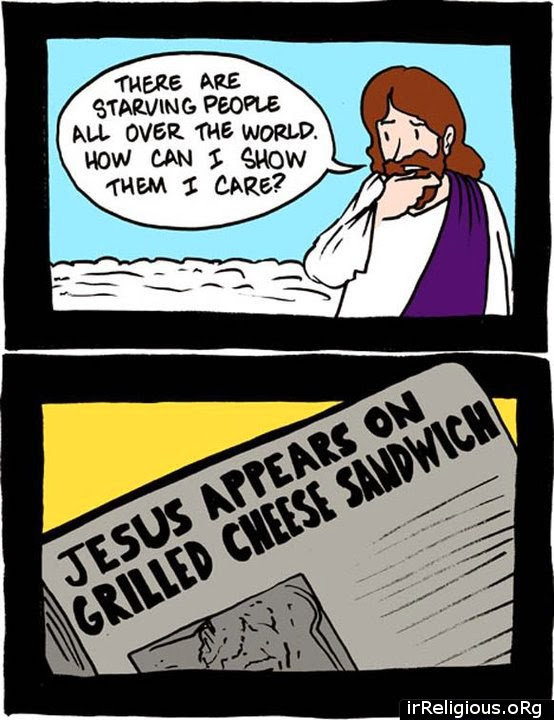
Kid logic in action: Jesus starts a food bank
A quick disclaimer: If you haven’t picked up on it yet, I live for sarcasm, so some of these posts may not be appropriate to actually say to your little ones, but we sure can laugh about it behind their tender little backs, can’t we?
Yes, we can.
This morning, my little dude approached me, with his little blonde head cocked to the side, and asked me how long ago Jesus started the first food bank.
A-say-what?
“Did someone tell you that Jesus started the first food bank?”
“Yes, Ms. Blah Blah.” This is his math teacher. Math teacher. She is teaching him logical thinking.
Lord have mercy on her soul (#NoHoly).
I can’t lie, my blood was starting to boil at the idea, kind of suppressing my simultaneous desire to piss myself laughing. Food banks? Where the fuck did she get food banks from? Is this some new book of the bible? The Book Of NGOs? Jesus feeds the world, except Africa?
Before we go any further, a little background info. My son goes to a private Montessori school. We pay for him to attend. We chose this school because public schools in Canada are geared toward one type of student and one type of student only, while there are many ways to learn. I wanted my son to have the best possible chance of being taught in a way that he learned best and that’s why I chose student-led Montessori.
I did my homework on this school, and we took a trip before we moved here to visit it and take a tour. While my husband and I were shown around, I asked, “there is no religious affiliation here is there?” to which the administrator responded that there was none. I thought I was free and clear of having to deal with my little one being taught horseshit.
So, you can imagine my surprise when I heard that his math teacher was telling him lies.
“What exactly did she say, sweetie?”
“She said that Jesus lived a long time ago and now he is dead and food banks were his idea.”
Goddamnit. No fucking holy.
“You know that’s not necessarily true right?”
“It is true, Mommy! Ms. Blah Blah said!”
Now I’m mad. I’m scowling as I picture myself marching into the administrator’s office, blaspheming like satan on Christmas and demanding a fucking answer.
I bite my lip and kneel down.
“Honey, some people believe that Jesus was real and that he was magic. You can believe it if you want to, as well. I just want you to know that Mommy and Daddy don’t believe it and there is no proof that it is true. Sometimes, even adults can get mixed up about what’s real and what’s not.”
He looks at me confused. “But, why, Mommy?”
I’m thinking Because they’re fucking morons.
I say instead, “because sometimes believing things that are not true brings people comfort.”
His little arms are around me now, my favourite fucking thing in the world. He asks, “like this, Mommy?”
“Exactly! But we don’t need to believe stuff that might not be real for comfort because we have each other for that, don’t we?”
His little Dennis the Menace cowlick wobbles as he nods his head up and down.
Cue the effing Full House music, I just Danny Tanner’d my way through the Jesus talk, bitches!
How would you have dealt with this situation? What would you have told a five-year-old boy asking these things?
What I would add now
The heart of that answer still holds: identify the belief, be honest about what you believe, and give the child room to think. Today I would make the label even clearer:
“Christians believe Jesus was the son of God and did amazing things. Mommy and Daddy don’t believe the supernatural stories are true. People have different beliefs, and it’s okay to ask how they know.”
That wording separates a religious claim from an established fact without asking a five-year-old to carry an adult fight into math class.
Kid logic in action: the cathedral bird bath
After the food-bank conversation, I asked readers on Twitter and Facebook what questions their own kids had asked about religion. Someone sent me the cathedral story, and it was too funny not to share: a child looked at the holy-water fonts and decided they were bird baths.
Another child saw the holy-water fonts in a cathedral and interpreted them as bird baths. Honestly, solid hypothesis. They looked like basins, they held water and nobody had explained the ritual.
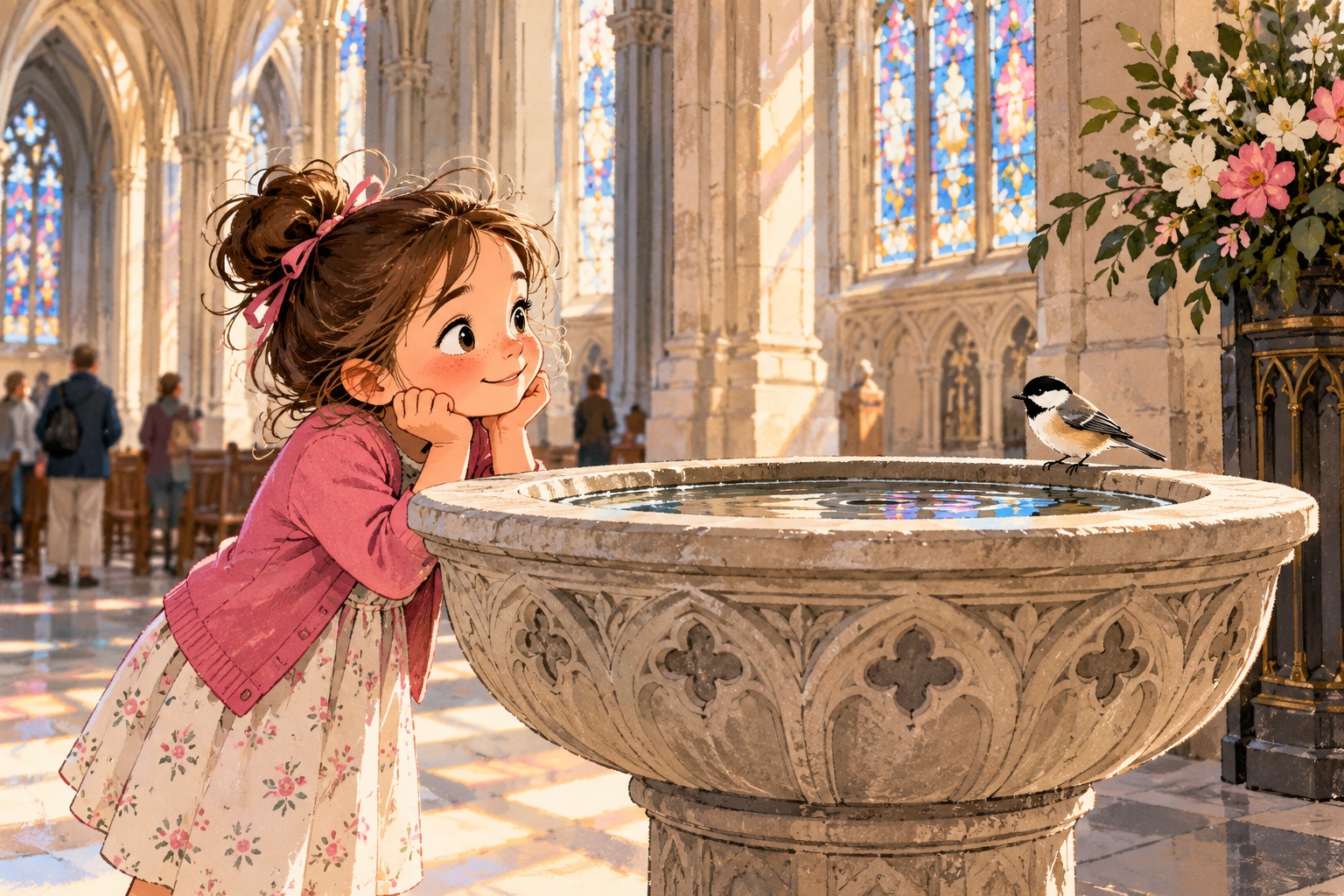
What the child is really asking: What is that object, and why are adults touching the water?
A simple secular answer: “Catholics use that water in a religious ritual. They believe it has been blessed. Other Christians use different rituals, and people who are not religious don’t believe the water has special powers.”
A deeper answer: Ask what clues made it look like a bird bath, then compare religious rituals with other symbolic traditions. The funny observation becomes a lesson in inference without teaching the child to sneer at the people participating.
How much detail should you give?
Ages 4 to 6
Keep it short, concrete and neutral. “Grandma prays because she believes God hears her. We don’t believe that, but we love Grandma.” One idea at a time is plenty.
Ages 7 to 10
Introduce religious diversity, atheism, myths, traditions and evidence. Ask, “How could we find out?” Explain that sincere people can believe different things and sincerity does not make a claim factual.
Tweens and teens
Talk about philosophy, morality, history, institutions, power and how evidence is evaluated. Let them disagree with you. A teenager who can challenge your view respectfully is practising exactly the skill you said you wanted them to learn.
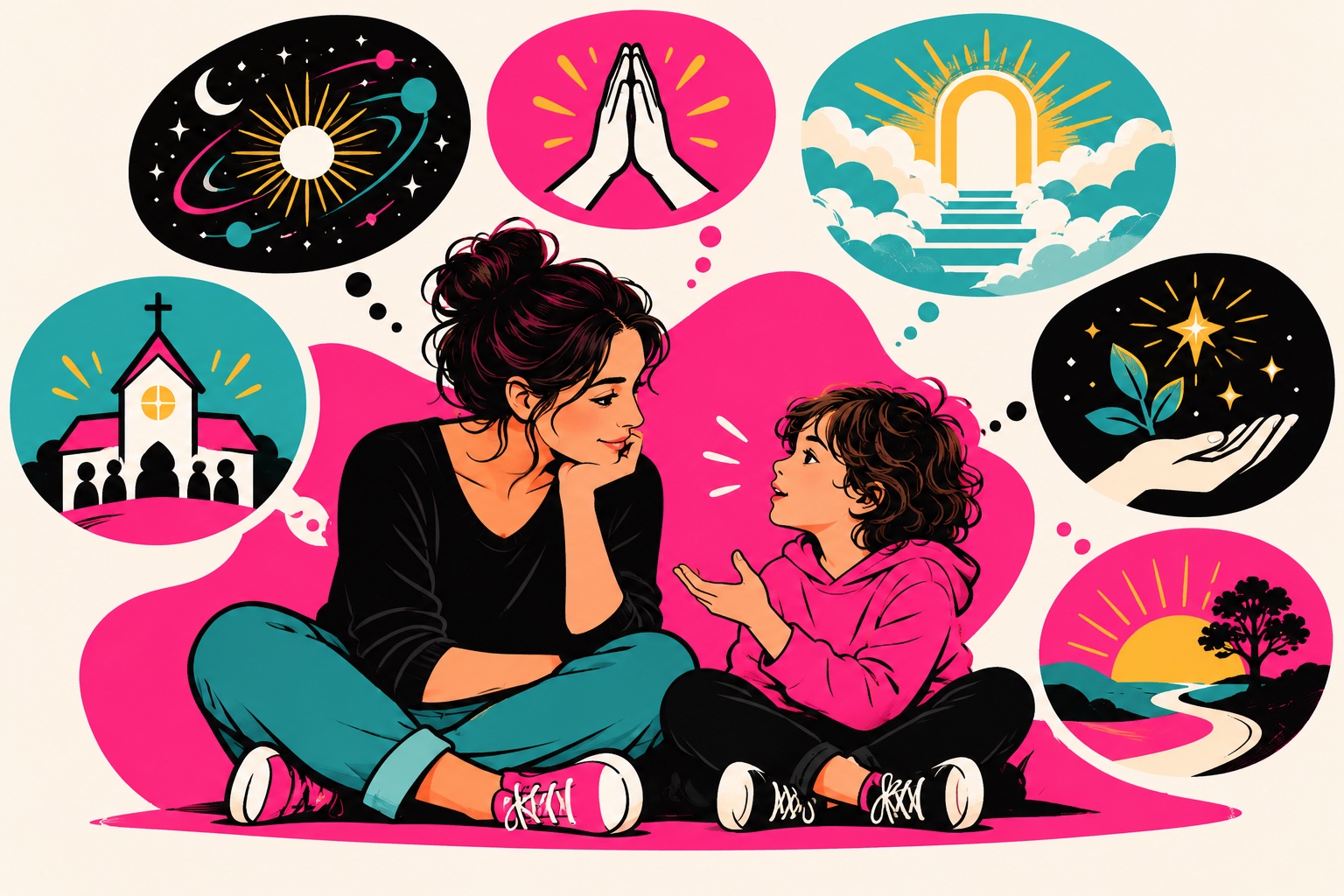
What to say when kids ask the big questions
Who is God?
“God is the name people use for a supernatural being they believe created or controls the universe. Religions describe gods in different ways. Some people believe in one, some in many and some, including us, are not convinced any gods exist.”
Why do people pray?
“Some people pray to ask a god for help, say thank you or feel connected to their religion. It can make them feel calm. Feeling comforted is real, but it does not prove someone supernatural is listening.”
What is heaven?
“Heaven is an afterlife that some religions teach about. Different religions describe different afterlives. Nobody has reliable evidence showing what happens after death.”
Why do people go to church?
“People may go to worship, see friends, follow a family tradition, get help or feel part of a community. We can build community in other places.”
Are miracles real?
“A miracle is an event someone believes a god caused. Before calling something supernatural, we can ask what happened, what evidence we have and whether there are ordinary explanations.”
Why does Grandma believe in God?
“Grandma has experiences, traditions and reasons that make belief meaningful to her. We can respect Grandma as a person without pretending we agree with every idea she has.”
My friend said I’m going to hell
“Your friend may have been taught that and may be frightened too. You are not bad for asking questions. You can say, ‘I don’t believe in hell, and I don’t want you to threaten me with it.’ Then tell an adult if it keeps happening.”
What happens when we die?
“Bodies stop working. Nobody knows of reliable evidence that a person continues living somewhere else. The people we love continue to affect us through our memories, stories and everything they taught us.” For more help with this conversation, read Lying to Your Kids: The Seductive Comfort of Heaven.
Four habits that make these conversations easier
- Label the claim. Say “Christians believe” instead of “this is what happened.”
- Say “I don’t know.” Intellectual honesty is not a parenting failure.
- Ask what your child thinks. Their reasoning tells you more than a quiz on your own conclusions.
- Protect people while challenging ideas. “That claim has no evidence” is different from “everyone who believes it is stupid.”
For more practice, see 11 Ways to Make Sure You’re Raising Critical Thinkers. If religious grandparents are part of the equation, try Atheist Grandma, Christian Granddaughter. Religious parents with an atheist child can start with My Child Is an Atheist.
A small secular parent’s bookshelf
This is the short list. A full buyer’s guide for secular families is coming separately, organized by age and conversation. This section contains Amazon affiliate links. If you buy through one, Godless Mom may earn a commission at no extra cost to you.
- Parenting Beyond Belief, edited by Dale McGowan: best for parents who want a broad secular-parenting foundation. It is an adult resource, not a children’s storybook.
- Grandmother Fish by Jonathan Tweet: best for preschool and early-elementary conversations about evolution. The interactive format works well with younger kids.
- The Belief Book by David G. McAfee and Chuck Harrison: best when children have started asking why people believe different things. Read together and discuss rather than treating it as a final answer.
- Maybe Yes, Maybe No by Dan Barker: best for introducing skepticism and asking for evidence. The examples are simple enough for many elementary-aged readers.
- What Do You Believe? from DK: best for a visual introduction to world religions and nonreligious worldviews. Use it as a map, then look for voices from within each tradition.
The point is curiosity without contempt
Religion can cause real harm. It can teach children that their natural humanity is sinful, that questions are dangerous and that love depends on obedience. I will criticize those ideas without softening a single edge.
But your kid does not need to learn that religious people are a different species. Grandma is still Grandma. Their friend is still their friend. Teach them to inspect claims ruthlessly and treat human beings as human beings.
And when you do not know the answer, say so. Then look it up together. That might be the most useful secular family ritual of all.


Comments
Join the conversation. New comments are reviewed before appearing.